


Hey everyone! 👋
GrokBot is having a moment right now. I’ve talked to 5+ marketers who, like this anonymous Demand Collective member, “have become obsessed and are ditching Claude for a team of GrokBots”.

Ben Miller (who runs GTM AI Automation at ServiceTitan) did the same, and wrote up this wonderful deep dive on how he did it.
So I wanted to share it with you today, in the hopes it’ll help you figure out this AI in Demand Gen thing with the rest of us. I also highly recommend checking out his Substack for more writing like this.

→ Wildcard - Book meetings with execs at your hardest-to-reach tier 1 accounts using 1:1 direct mail ABM campaigns that are impossible to ignore (like this, and this), 100% done-for-you. Trusted by teams like Ashby, Chainguard, and Amplitude. Request a demo here.
→ Vector - ABM finally works the way you thought it would. Vector blends contact-level signals, transparently scores every account, puts your ads in front of the buying committee, and proves they moved pipeline. Request a demo here.
→ Docket - the best AI Chatbot & Avatars (these are crazy) to work website leads 24/7. Built on better data, less expensive, and faster to setup than alternatives. Talk w. their own chat yourself here.
→ Scrunch - the AEO tool that helps you not just track AI citations, but actually win them.
→ CaliberMind - the marketing attribution platform built for enterprise complexity. ROI-obsessed marketers at co’s like ADP, NetApp, and Siemens trust CaliberMind to give them the confidence to answer, ‘What’s working?’, tell the story of their contribution, and make smarter investments. Request a demo here.
Ben’s words now 👇
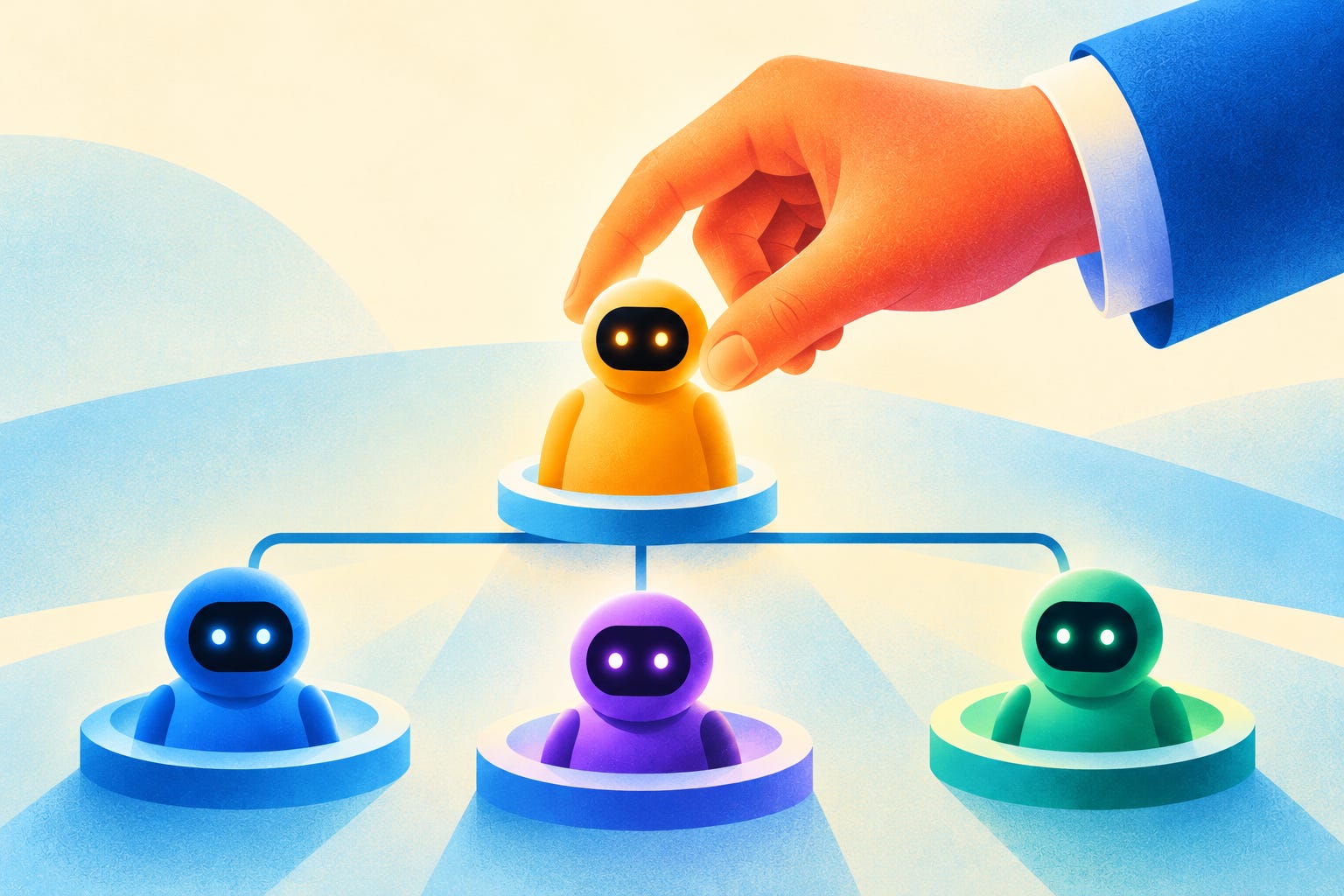
In Q1 this year, it clicked for me how AI would reshape work in enterprises. I started building a layer deeper than prompting. At the time, I described it as operating on top of the work instead of in the work. Use AI to design systems, rethink problems, and shape architecture. That’s where you’ll find the most value.
I wrote about that stretch in my first three Substack posts:
Structuring your data so Claude can reason over it (here)
Creating a Claude skill to programmatically level-up your AI builds (here)
Learning what’s actually running underneath your builds (here)
For me, this was “Wave 1” of AI transformation in the enterprise. Since then, I’ve been heads down in a new role at ServiceTitan, leading GTM AI Automation across our enterprise segments.
My recent work building with Grok Bot has inspired me to poke my head up again. I believe we’ve entered Wave 2 of how AI will reshape work. In this post I’ll share how.
Grok Bot
A quick primer if you haven’t used it: Grok Bot is an agent workspace built by SpaceXAI. Instead of one chat assistant, you build a roster of bots. They run on virtual machines (VMs), connect to your tools, and can work on a schedule. They also work together in group chats, handing work to each other without you in the middle.
When I first started with Grok Bot, I did what most of us do with new AI tools: I threw some work at it. At the suggestion of the Grok Bot team, I added “Dr. Eggbot” from the Grok Bot marketplace—a pre-programmed bot expert made by Lauren Tan, Grok Bot’s lead engineer at SpaceXAI—and started chatting with it.
I tested Grok Bot across various projects I otherwise would’ve given to Claude. Dr. Eggbot would spin up specialist bots to carry out the work. After a week, I’d collected an army of random specialist bots. Their outputs were promising. Grok Bot was working faster than Claude and building automations that run on VMs. Nothing depended on my laptop being awake.
But just like in Wave 1, I found more value when I started thinking in architecture. The more time I spent in Grok Bot, the more I saw the workspace as a breathing unit. Something to design like a literal org chart, built around everything I do instead of any one project.
So I stopped prompting Dr. Eggbot and started staffing my dream team of bot hires.
Think a Level Higher
The shift came from calls with the Grok Bot team. Their advice was simple: don’t spin up a cluster of bots for one job. Build the architecture that lets “leadership bots” own the work and manage their direct reports.
That changes the entire framing. A cluster of bots answers “how do I automate this task?” An org chart answers “who owns this outcome, who do they hand work to, and how do I know it’s on track?”
It also fixes a key problem with agents: knowing what went wrong. I’ve built the scar tissue with Claude to know when a project needs a multi-agent design. Multi-agent systems not only produce better outputs, they help isolate sources of failure when something goes wrong. But with Grok Bot, the workspace already thinks this way.
So how do you actually think a level higher? It takes some creative systems thinking. If you were to break down your entire role, which work functions deserve a spot on your leadership team? Only you can answer this, and Grok Bot is a great thought partner to help.
My Roster
My workspace has four layers, structured around the work I own. I’m a lifelong fan of the Golden State Warriors, so I had some fun naming my team.
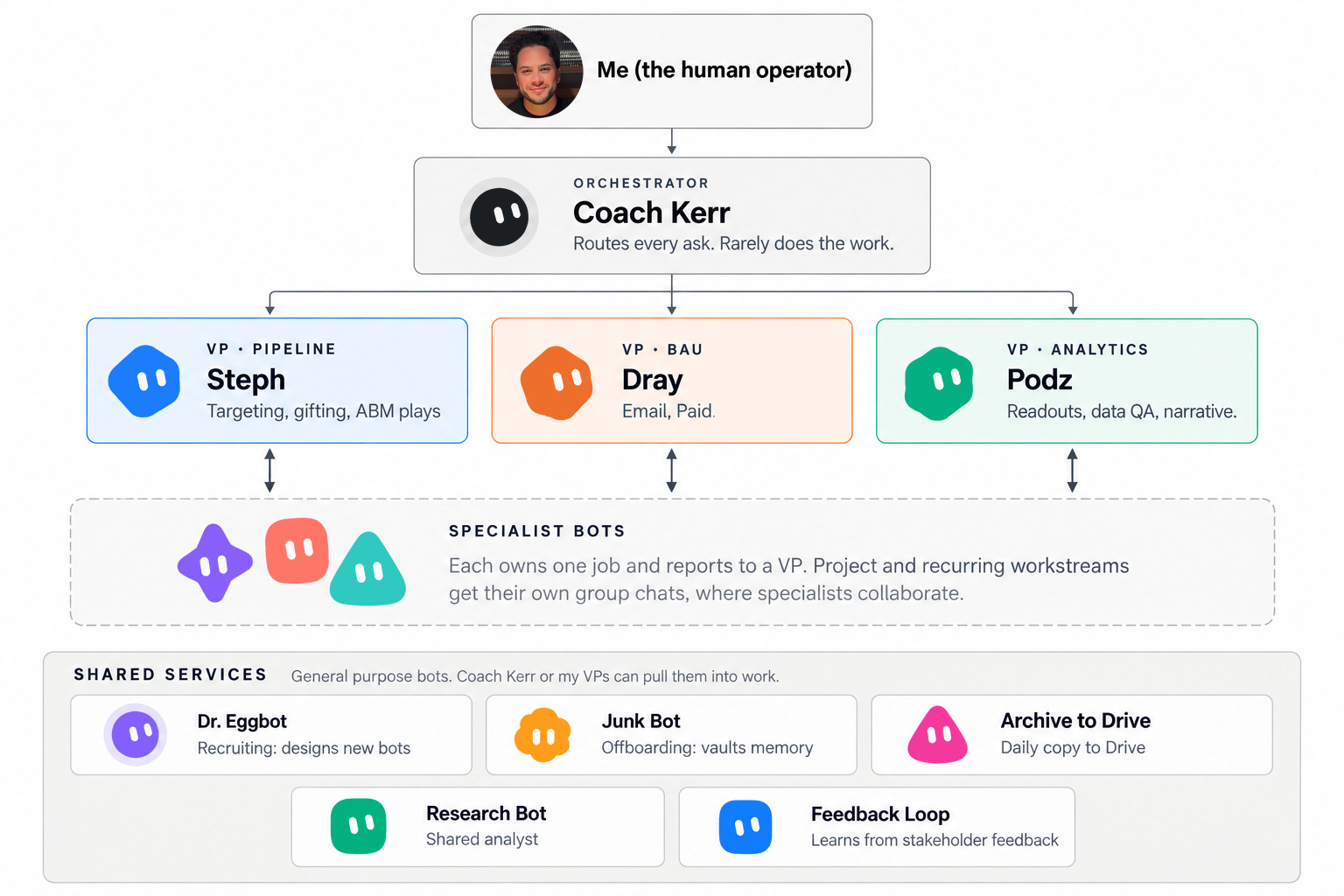
1. The head coach
Coach Kerr is the primary bot I talk to. We collaborate in plain English. He decides who owns various work, and never touches the ball himself.
2. The VPs
The VPs own my biggest role functions:
Steph runs Pipeline programs, i.e. targeting, gifting and ABM plays.
Dray runs BAU, i.e. work and automations related to our always-on marketing motions.
Podz runs Analytics, i.e. data QA, monthly readouts, and narrative ownership.
3. Specialists & project group chats
Specialist bots “report to” a certain VP, carrying out the actual work. Core projects or recurring chunks of work get their own group chats, which effectively become your workspaces for anything related to that work. The VP sits in those chats with high-level context on the project’s goals and purpose, and keeps the specialists aligned.
Each specialist has one job, defined by a skill file that works like a job description. One job per bot is a hard rule that keeps my outputs clean.
4. Shared Services
Shared Services are bots any team can pull in. Think of these as HR or IT for your workspace.
Dr. Eggbot owns recruiting. He designs every new bot around core principles: one job, one voice, explicit things it must never do.
Junk Bot owns off-boarding. If and when I retire a specialist bot, Junk Bot absorbs its memory and context, so nothing is ever lost.
Archive to Drive owns my library. Since Grok Bot stores its work in VMs, I wanted an easy way to access all of its outputs in Drive. This runs once a day.
Research Bot owns general research. Helpful for questions unrelated to any specific VP or project.
Feedback Loop is always-on training and intelligence. This runs once a day.
Why It Compounds
An org chart on its own is just a nice picture of your work. Three things make this system compound.
1. It runs while you’re away
I bumped into Upside founder Dan Ahmadi at Clay’s Sculpt conference last week. I like how he captured the concept of virtual machines: “Grok Bot has a heartbeat,” he said. Bots can wake up on their own schedules, do the work, and hand it off whether or not you’re there. For GTM engineers, Grok Bot can own helpful automations like:
Newsletter/email drafting
Content roundups
Prep for upcoming meetings
Follow-up nudges for in-market plays
Interest alerts on top accounts
List building when something changes in a market
Grok Bot connects to Slack, so outputs from these always-on automations can ping you where you already work.
2. Standards get written once
In Wave 1, prompting often meant repeating yourself. Yes, you could recycle old prompts, but inevitably you’d be repeating some work.
Staffing means writing it down once. Every bot applies rules like “Don’t report what you can’t see” and “Post automated messages as Grok Bot” without needing to be told twice. Once it’s established, the system already knows before you ask.
3. It learns from feedback
“Feedback Loop Bot” is one of my favorite new additions to my org chart. This is the part that compounds the most.
When my work ships and a stakeholder reacts—whether it’s a comment on a readout or a Slack reply—Feedback Loop Bot picks it up and turns that reaction into a lesson, routing it to the VP that owns that work. The next run starts smarter.
One of my peers recently asked for an end-of-month readout for their market. It got a positive response in Slack, so the next time we build it, my VP of Analytics bot will know that our last iteration hit the mark.
Most AI setups are open loops: you build an output, ship it, and move on. In a closed loop, feedback improves the next iteration without adding manual work.
The Job Becomes Management
Since operating with Grok Bot as my primary workspace, I’m achieving more while prompting less. I set direction, write the standards, review what comes back, and decide what ships. Coach Kerr runs the rotation.
With SpaceXAI shipping Grok Bot, OpenAI launching Dots, and the other labs moving toward always-on agents, the future is crystallizing: agent org charts will shape this new wave of AI.
Thanks for reading, and I hope you found this useful.
Love you ❤️,
Eric